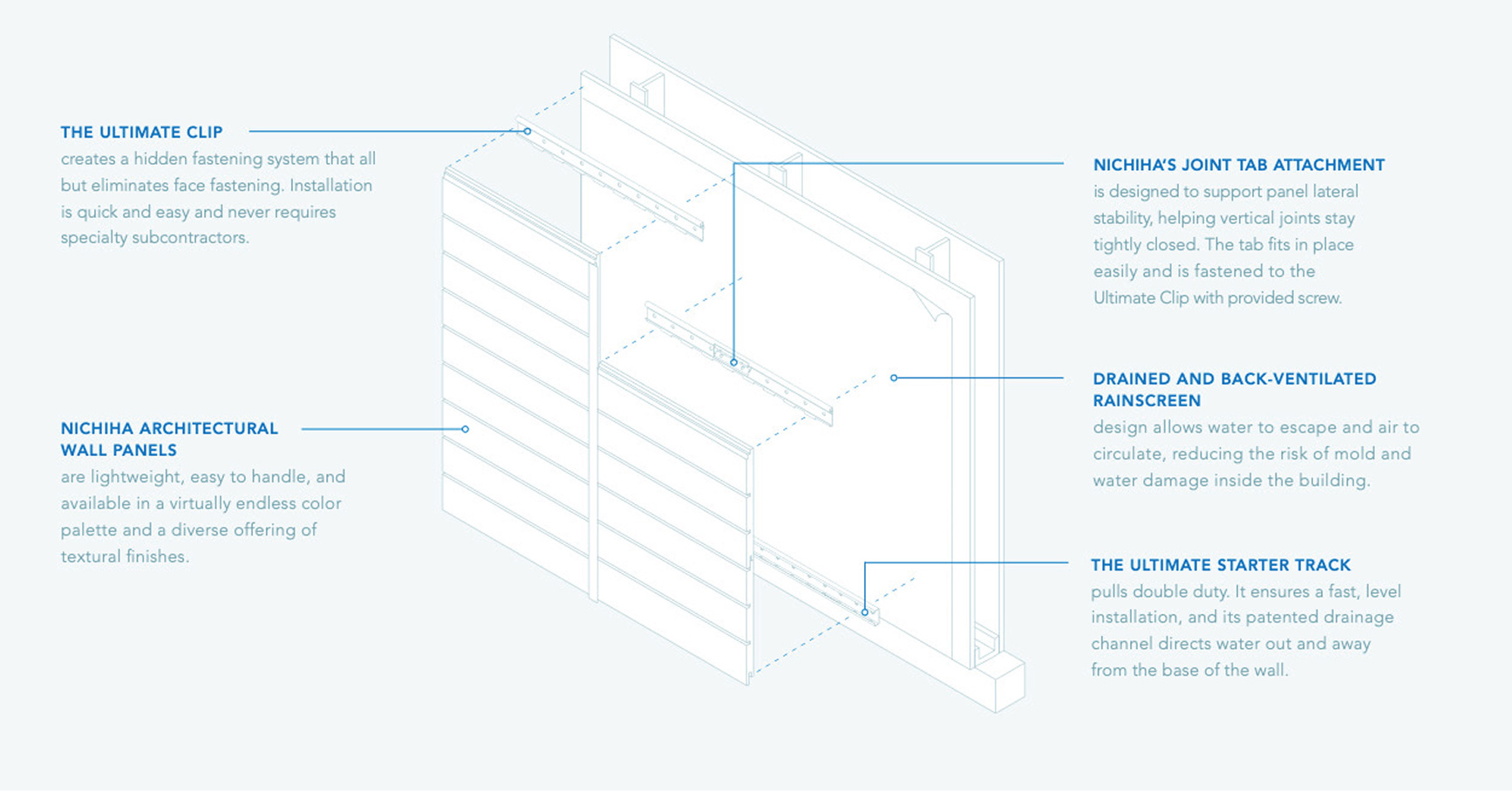
Starter flashing is one of the base-of-wall details that helps an architectural cladding system maintain clean alignment while supporting drainage at the bottom edge. Below are quick FAQs that explain what Nichiha starter flashing does, and how it fits into a rainscreen-style approach to managing water intrusion.
What is starter flashing, and why is it important for siding and panel cladding systems?
Starter flashing for siding and panel systems is a metal flashing installed at the bottom edge of a wall in conjunction with the Nichiha Ultimate Starter Track to help establish a clean line and support drainage behind the cladding.
In an architectural wall assembly, base conditions take a lot of exposure from splashback, wind-driven rain, and runoff, so architectural flashing is commonly treated as part of the system design, not an afterthought. Nichiha starter flashing is designed to coordinate with Nichiha architectural wall panel accessories and assemblies so the base of the façade stays tidy.
How does starter flashing support moisture management and long-term wall performance at the base of the façade?
Starter flashing supports moisture management by helping provide a controlled path for water to exit at the base of the wall. In a closed-joint assembly like Nichiha’s, the panel system is designed to limit water entry at the face, but base-of-wall flashing details are still important for managing incidental moisture at transitions and helping protect vulnerable lower wall conditions.
Used as rainscreen flashing, starter flashing helps direct water down and out at the base, which reduces the risk of repeated wetting at the bottom edge. Paired with coordinated flashing details and a water-resistive barrier (WRB), it supports long-term wall performance.
When would a project also use inside corner flashing, outside corner flashing, or other trim accessories?
A project uses these materials when the base condition turns corners or transitions into other edges that need continuity of water control and alignment. Corners concentrate complexity because multiple planes meet, and that is exactly where unmanaged water intrusion can show up first.
Inside and outside corners can also be a visual focal point, so using dedicated corner accessories can help maintain consistent lines and crisp geometry. Teams often reach for coordinated corner components when the design intent calls for a refined perimeter or when base-of-wall flashing continues around a return.
How does Nichiha starter flashing relate to starter track and panel alignment in an architectural wall panel system?
Our flashing relates to the Nichiha starter track by supporting a controlled base condition while the starter track establishes the system’s initial reference for panel placement. Think of the starter track as the alignment foundation for the panel field, and starter flashing as part of the base-of-wall water-management and finish logic that helps the starting edge look properly composed.
On big elevations, tiny variations at the bottom can become more noticeable as the panels continue up the wall, making reveals and shadow lines feel uneven. Treated as a coordinated pair, starter flashing and starter track help keep the first course visually disciplined so the rest of the elevation can maintain consistent rhythm and clean alignment. Because Nichiha starter flashing is supplied in 10-foot lengths, it supports continuity across long runs of wall.
If someone refers to a siding starter strip, they may be describing the same base-of-wall concept in general terms, but in an architectural panel context the goal is the same: define the start line, support system alignment, and help manage water at the lowest edge of the façade.
Why do specifiers treat flashing details as part of the overall exterior cladding performance strategy?
Specifiers treat flashing details as part of the exterior cladding performance strategy because water management is a system behavior, not a single product feature. The face of the cladding is only one layer of defense. The WRB, the drainage plane, and the flashing network work together to manage incidental moisture and lower the likelihood of hidden damage.
This is especially true for flashing for fiber cement siding and architectural wall panels, where the design intent often depends on clean lines and consistent joint expression. When base flashing and corner conditions are properly designed instead of left to field improvisation, the assembly is better positioned to handle real-world exposure and reduce the risk of recurring moisture problems at the base.